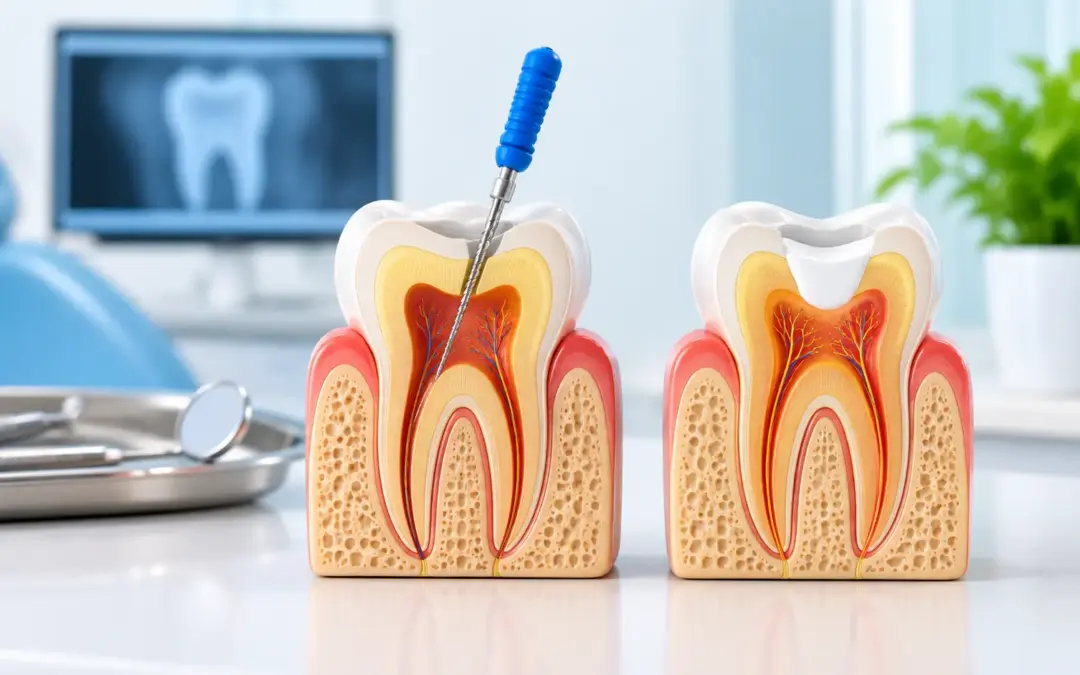
Every tooth has a small bundle of nerve and blood vessels at its centre, called the pulp. What your dentist does about a deep cavity depends on one thing: is that pulp still in good shape? If it’s healthy, or just a little inflamed, it can usually be covered with a protective dressing and left alive. If it’s badly infected or has died, it has to come out, and that’s a root canal. So pulp capping vs root canal isn’t about one being stronger than the other. The dentist decides after listening to your symptoms, looking at an X-ray, and testing how the tooth reacts to cold.
According to Dr. Uttkarsh Shah at The Smile Connect, a Dental Clinic In Kandivali, Mumbai, “Having a deep cavity doesn’t mean you’ll need a root canal. We always try to keep a healthy nerve alive. But when the tooth is infected, or it aches on its own, the nerve can’t be rescued and a root canal is the right call.”
When Is Pulp Capping Used Instead of a Root Canal?
Capping is meant for a nerve that’s still alive and able to heal. The dentist puts a mineral-based dressing over the spot where the pulp is exposed, or nearly exposed, and then seals the tooth with a filling. Easy to describe. The tricky part is knowing the nerve is only irritated, which is what reversible pulpitis means.
- Short, sharp twinges: Cold water or something sweet makes the tooth zing for a few seconds, then it settles. That quick recovery is the good sign.
- Decay that stops short: The cavity is deep and close to the nerve but hasn’t infected the pulp, so the dentist can clean it out and still protect the pulp.
- A pinprick exposure: Now and then the nerve shows through as a tiny dot while decay is being removed. If bleeding stops fast and the area is clean, it can be covered right then.
- No ache on its own: The tooth stays quiet unless something touches it. No night-time throbbing, and no pain that outlasts a cup of hot tea.
When the nerve is past saving, the treatment of choice is root canal treatment, covered next.
When Does a Tooth Need a Root Canal Instead?
A root canal is the answer once the nerve can’t recover. That usually means irreversible pulpitis, a dead nerve, or an abscess forming at the root tip. Past the point of recovery, basically. Oddly enough, a tooth with a dead nerve can feel better than one that’s still dying, so a quiet tooth isn’t always a healthy one.
Question | Pulp capping | Root canal |
Nerve condition | Healthy, or mildly inflamed | Badly inflamed, infected or dead |
What happens | The exposed pulp is covered with a dressing and the tooth is sealed | The damaged pulp is removed, the canals are cleaned out, and the space is filled |
The nerve afterwards | Still alive | Removed, though the tooth stays in your mouth |
Visits | Usually one | One or two, and often a crown afterwards |
- Pain that hangs around: If a hot or cold drink sets off an ache that lasts a few minutes or longer, the nerve probably won’t settle on its own.
- Pain from nowhere: Throbbing that starts without any trigger, or wakes you up at 2 a.m., usually tips the decision toward a root canal.
- A pimple on the gum: A small bump or swelling near the tooth means infection has found its way out past the nerve.
- A tooth that’s changed colour: Greying, or soreness when you bite down, can mean the nerve has died. The X-ray often shows a dark shadow at the root tip.
How a root problem can show itself years later is covered in this read on root canal infection.
Wondering whether the deep cavity in your tooth can be capped, or is heading for a root canal?
How Long Does a Pulp Cap Last, and Is It Worth It?
There’s no fixed expiry date on a pulp cap. A review of 14 studies found that around 81 to 84 percent of MTA-capped teeth were still fine two to five years on, although many of those studies weren’t high quality. Worth it, in the right tooth.
- What goes on the nerve: MTA and Biodentine did better than the older calcium hydroxide in that review. The filling or crown over it has to seal well too, since any leakage lets bacteria back in.
- What you gain: A living nerve, and a smaller procedure than a root canal. And if the cap does fail, a root canal is still possible, so you haven’t lost that option.
- Review visits: The dentist will usually want an X-ray and a cold test a few months later. Come back sooner if the pain returns, or you notice swelling or a bump on the gum.
- Crown after a root canal: Not every tooth needs one. A front tooth with most of its structure intact can sometimes get by with a filling. Molars and premolars usually need a crown, because a tooth without a living nerve is more likely to crack.
Why most root-treated teeth end up with one is covered in this read on a root canal crown.
Key Takeaways:
Capping is for a nerve that is healthy or mildly inflamed, and a root canal is for one that is badly damaged, infected or dead. Neither wins in general, since the diagnosis decides. A well-sealed cap can last several years, and most root-treated back teeth also get a crown. Pain that lingers, wakes you at night or comes with swelling needs to be seen soon.
FAQs
Which is better, root canal or pulp capping?
It depends on the nerve. Healthy ones get capped, damaged ones need root canals.
Is it mandatory to do capping after a root canal?
Not for every tooth, but molars usually need a crown to avoid cracking.
How long will a pulp cap last?
Often for several years, if the nerve was healthy and the seal holds.
Is pulp capping worth it?
Yes, for a healthy nerve. It can spare you a root canal.
References
- Efficacy of direct pulp capping for management of cariously exposed pulps in permanent teeth: a systematic review and meta-analysis – PubMed
- Outcomes of vital pulp therapy in permanent teeth with different medicaments based on review of the literature – National Center for Biotechnology Information (PMC)
Disclaimer: This blog is for educational and informational purposes only and should not be considered professional advice.