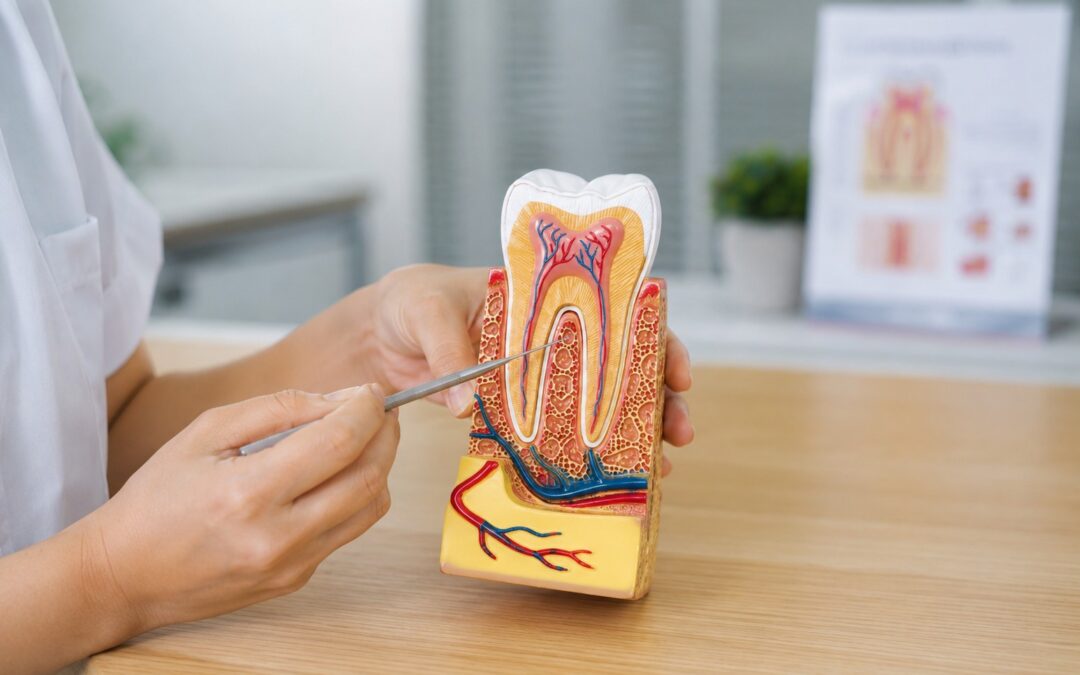
A root canal rarely announces itself politely. It usually starts as a toothache that just won’t quit, nagging whether you’re eating or not. Then hot and cold begin to sting, and the ache hangs around long after you’ve finished your tea. Some people get a small pimple on the gum that keeps coming back. Others notice one tooth going grey while the rest stay white. Any of these can mean the pulp inside is infected, and once that sets in, a root canal is what clears it and saves the tooth before it has to come out.
According to Dr. Uttkarsh Shah and Dr. Mansi Shah at Dental Clinic In Kandivali, Mumbai, “Once the pain wakes you at night, the nerve is already dying. A root canal is what saves the tooth before it reaches the extraction stage.”
How Do You Spot a Tooth That Needs a Root Canal?
There are four signs worth watching for. One on its own might be nothing. Two of them together, and the pulp is usually in trouble.
- Lingering hot-cold pain: You sip something cold and it stings for minutes after, not seconds. That’s the nerve inflamed, not just doing its job.
- Pain at night: It throbs the moment you lie down. Lying flat sends more blood to the pulp, and the ache climbs with it.
- Gum boil: A little white or red pimple near the root. It bursts, settles, then turns up again. That’s pus finding its way out.
- Darkening tooth: One tooth goes grey or brown while its neighbours stay bright. Inside, the pulp has already died.
Pinning down the exact tooth takes more than a glance. A proper root canal work-up means an X-ray, a cold test, and a tap on each tooth until the sore one gives itself away.
When Is a Root Canal the Only Option Left?
Some teeth are too far gone for a filling, and antibiotics only buy a bit of time. Once the pulp is infected, the one thing that actually stops it is cleaning the canal out.
- Deep decay into the pulp: The cavity has eaten its way down to the nerve. It won’t heal, and capping it with a filling just seals the bacteria in.
- Abscess at the root: Pus has collected at the tip of the root. Antibiotics quiet it for a few days, then it’s back.
- Cracked into the nerve: The fracture runs deep. Deep enough to let bacteria straight into the pulp.
- Repeat work on one tooth: Filled once, then again, then again, until the nerve finally packs up.
A tooth that’s been through a root canal is hollow inside, and hollow means fragile. That’s why it nearly always needs a crown to follow. We’ve covered when that step turns urgent in our note on the early signs you need a dental crown.
Experiencing tooth pain or sensitivity? Don’t wait until it gets worse. Book a dental consultation today and protect your smile.
Why Choose The Smile Connect Clinic?
People usually find The Smile Connect after a tooth’s been nagging them for weeks. Dr. Uttkarsh Shah and Dr. Mansi Shah have spent over a decade on infected and dying teeth, the messy ones included. Every case opens with a digital X-ray and a pulp test, so the right tooth gets treated, not the one sitting next to it. Single-visit canals, retreatments, the crown that comes after, it’s all handled in one place. With digital X-rays and RVG, infection turns up early, well before it reaches the bone.
Still throbbing after a few days on painkillers? Don’t sit on it. A root canal now is cheaper and easier than an extraction later. Walk-ins are fine on weekday evenings, weekends run by appointment, and emergency calls get picked up the same day.
FAQs
Can a tooth heal without a root canal once the nerve is infected?
No, an infected pulp does not recover. It spreads until the tooth is removed.
Is a root canal painful?
No, the tooth is numbed under local anaesthesia, and the procedure relieves the pain you came in with.
How many visits does a root canal take?
Usually one or two, depending on how infected the tooth is.
Do I really need a crown after a root canal?
Most back teeth do. The treated tooth turns brittle and cracks without one.